
Shelby County Court Records After Arrest
After a Shelby County jail arrest, the custody record and the court record begin to split. Booking occurs through the Shelby County Detention Center, but court records are handled through the Kentucky Court of Justice and the Shelby County Circuit Court Clerk. The official court page identifies the Shelby County Judicial Center at 401 Main St., Suite 101, Shelbyville, KY 40065. Circuit Court Clerk Wendy B. Graney is listed for the clerk office, with Circuit Court at 502-633-1287 and District Court at 502-633-4736.
District Court is often the first court stop after a jail arrest because Kentucky District Court handles misdemeanors, traffic offenses, violations, arraignments, felony probable-cause hearings, juvenile matters, and other limited-jurisdiction matters. Circuit Court is Kentucky's general-jurisdiction court and is central for felony prosecutions and post-indictment proceedings. Jail custody, court division, charge level, and prosecutor review may all affect where the next record appears.
The local court contact block was captured from the Kentucky Court of Justice Shelby County page, which is the official source for clerk location and phone numbers.
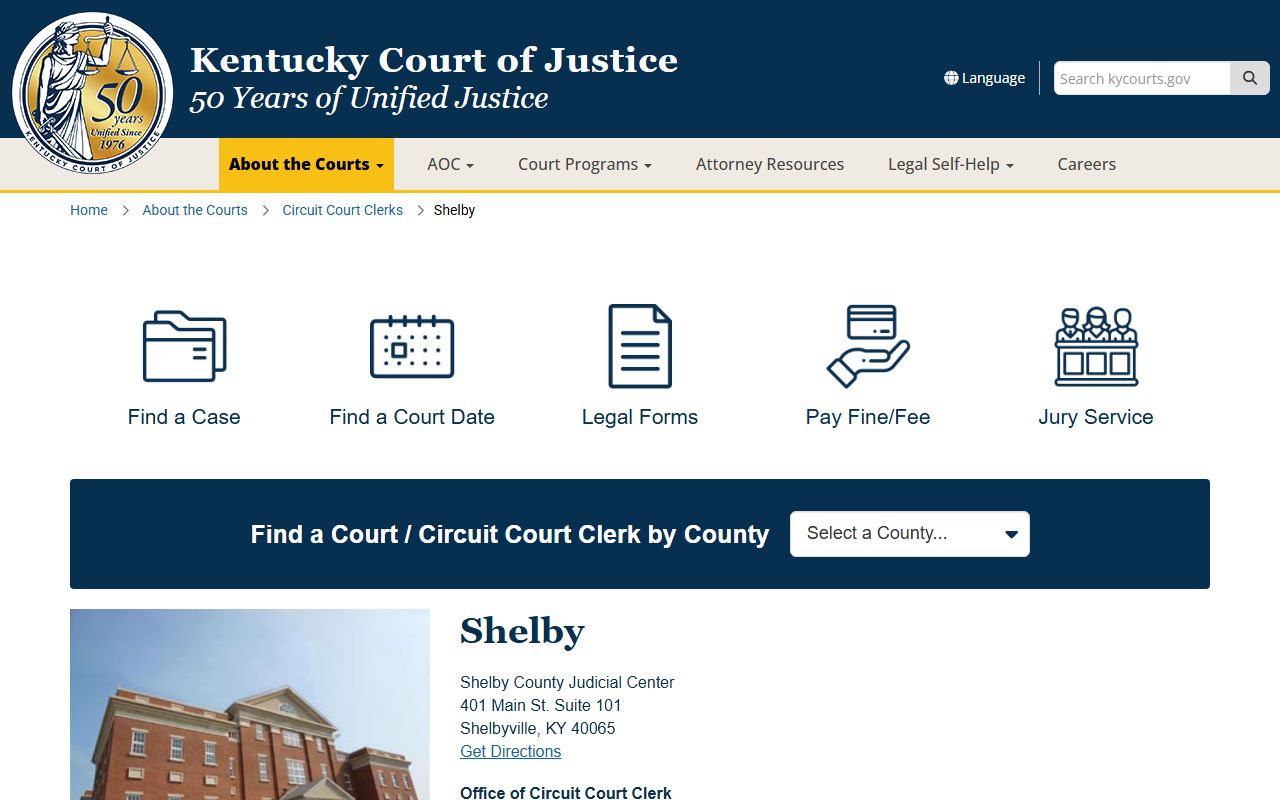
That clerk information is the verification point when an online docket entry is incomplete, unclear, rescheduled, or needs certified copies.
Find Shelby County Court Records
The Kentucky Court of Justice docket portal is the public web path for checking upcoming docket information after a Shelby County arrest. The observed search controls include County, Division, Date, Courtroom, and Subdivision. Shelby County appeared in the county dropdown as value 1061. Division is selected as Circuit or District, and Date is required. Courtroom and Subdivision default to ALL in the observed form.
- Open the Kentucky Court of Justice docket portal and choose Shelby County in the county field.
- Select District Court for many first appearances, misdemeanors, traffic-criminal matters, and probable-cause hearings, or Circuit Court for felony and general-jurisdiction matters.
- Enter the hearing date, then use Courtroom or Subdivision only if the court notice or clerk gives that detail.
- Review the docket result as scheduling information, then verify official case records with the Circuit Court Clerk.
The docket portal must be used with care. Its disclaimer states that the docket is not official and is subject to change. Court dates can be continued, moved, or removed. The portal also warns against using the information for employment, licensing, or eligibility decisions. For official copies, certified records, or a complete file, the clerk remains the source.
| Docket Field | Observed Control | Use After Arrest |
|---|---|---|
| County | Dropdown | Select Shelby County for local case settings. |
| Division | Circuit or District radio choice | Choose the court level tied to the charge or hearing. |
| Date | Required date field | Search the scheduled court date, not the booking date. |
| Courtroom | Dropdown default ALL | Leave broad unless a notice gives a courtroom. |
| Subdivision | Dropdown default ALL | Leave broad unless the clerk or notice gives a subdivision. |
The form itself was captured from the Kentucky Court of Justice docket portal, including the search controls used for Shelby County court records after an arrest.
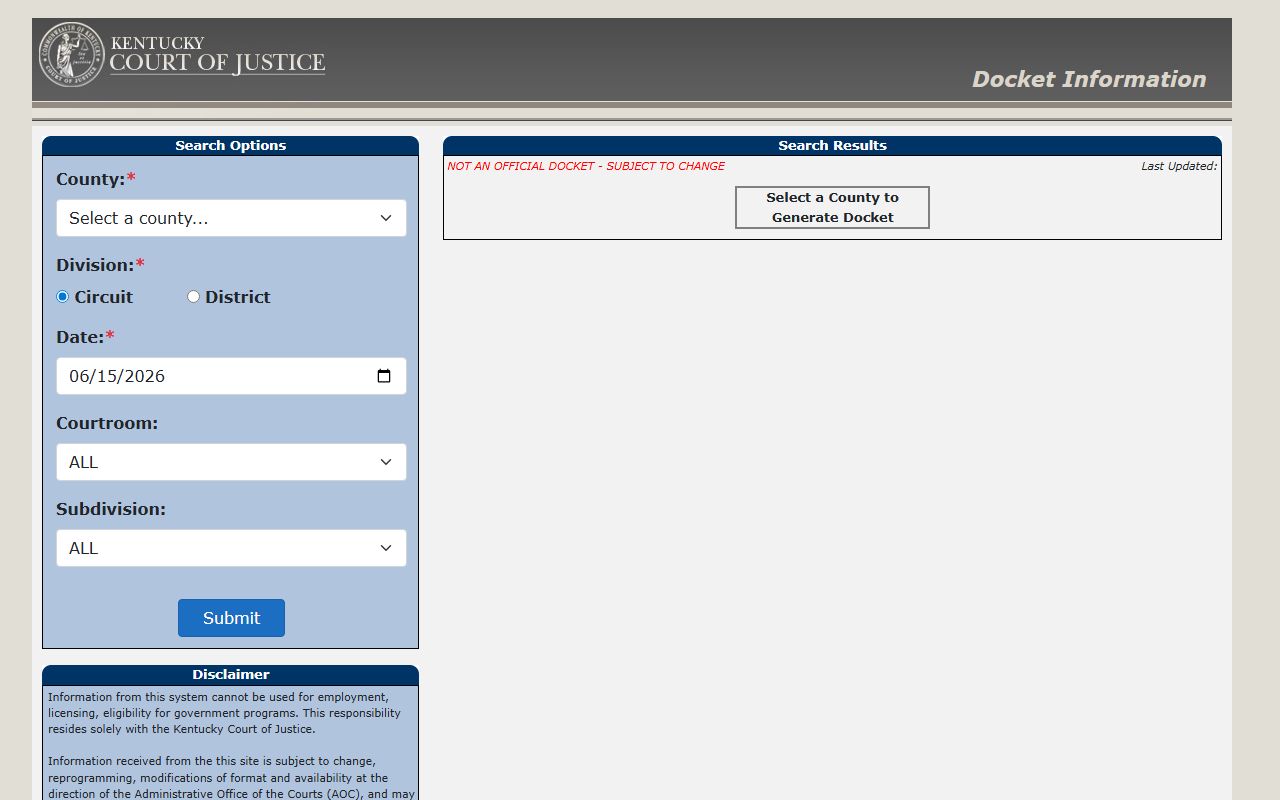
Use that portal for schedule checks, then use the clerk for the official file, copy requests, or docket questions that affect court attendance.
Charges After a Shelby County Arrest
The court record starts when a charging document moves the case into court. A jail booking may list an initial charge or hold, but that is not the final legal path. The prosecutor may proceed, amend, dismiss, or take the case to a different court level. The Shelby County County Attorney is verified as representing the state in Shelby District Court for criminal, traffic, and juvenile cases filed there, as well as dependency, neglect, and abuse matters in Family Court. Felony and post-indictment cases may involve the Commonwealth's Attorney, but a verified current contact block was not located in the research.
| Document | Common Source | What It Does |
|---|---|---|
| Complaint | Officer or prosecutor | States the accusation and commonly starts a District Court case after arrest. |
| Information | Prosecutor | Allows a prosecutor-filed charge when the law and case posture permit it. |
| Indictment | Grand jury | Moves felony allegations forward in Circuit Court after grand-jury action. |
For the custody side, use Shelby County jail inmate records. For photos tied to booking, use the Shelby County jail mugshots page. The court file is the place to check the charge as filed, not merely the reason someone was booked.
Shelby County Charge Status Records
Charge status can shift as a court record moves forward. A jail arrest may begin with one listed offense, then the prosecutor may file a different count, reduce the level, add a count, dismiss a count, or take no further action on part of the arrest. A docket can show hearings and some case status details, but the clerk file is the better source for the actual order, judgment, or disposition.
| Status | Plain Meaning | Record to Check |
|---|---|---|
| Pending | The charge is still open and has not reached final disposition. | Docket and clerk file. |
| Amended | The charge wording, level, or count changed during the case. | Court order or amended charging document. |
| Dismissed | The charge was ended by court action or prosecutor request. | Disposition order. |
| Convicted | The case ended in a guilty plea, verdict, or other conviction entry. | Judgment or sentencing order. |
| Expunged | Public access may be removed or restricted after a qualifying legal process. | Expungement order and clerk confirmation. |
Note: A docket entry can help identify a hearing, but the official court record controls the charge outcome.
Arrest Warrants and Court Records
The Shelby County Sheriff's Office is relevant to warrant service and criminal process, but it is not the custodian for every court record after arrest. The official county page lists Sheriff Mark Moore at 501 Main Street, Suite 8, Shelbyville, KY 40065, with 502-633-4324 for the office and 502-633-2323 for dispatch. Office hours are Monday-Friday, 8:30am-4:30pm. The sheriff FAQ describes court security, civil and criminal process, warrant service, patrol, investigations, school resource officers, tax collection, and related services.
If a warrant leads to a jail booking, the jail roster may show current custody while the court docket shows hearings. Active warrant packets, investigative material, victim information, and juvenile material may be restricted. Users should ask the arresting agency about police or sheriff reports and ask the Circuit Court Clerk about filed court records. The agency shown in the booking or court record matters because Shelbyville Police, Kentucky State Police, or another law-enforcement agency may be the actual arresting agency.
The sheriff service context was captured from the Shelby County Sheriff's Office FAQ, which describes the office's process and warrant-service role.
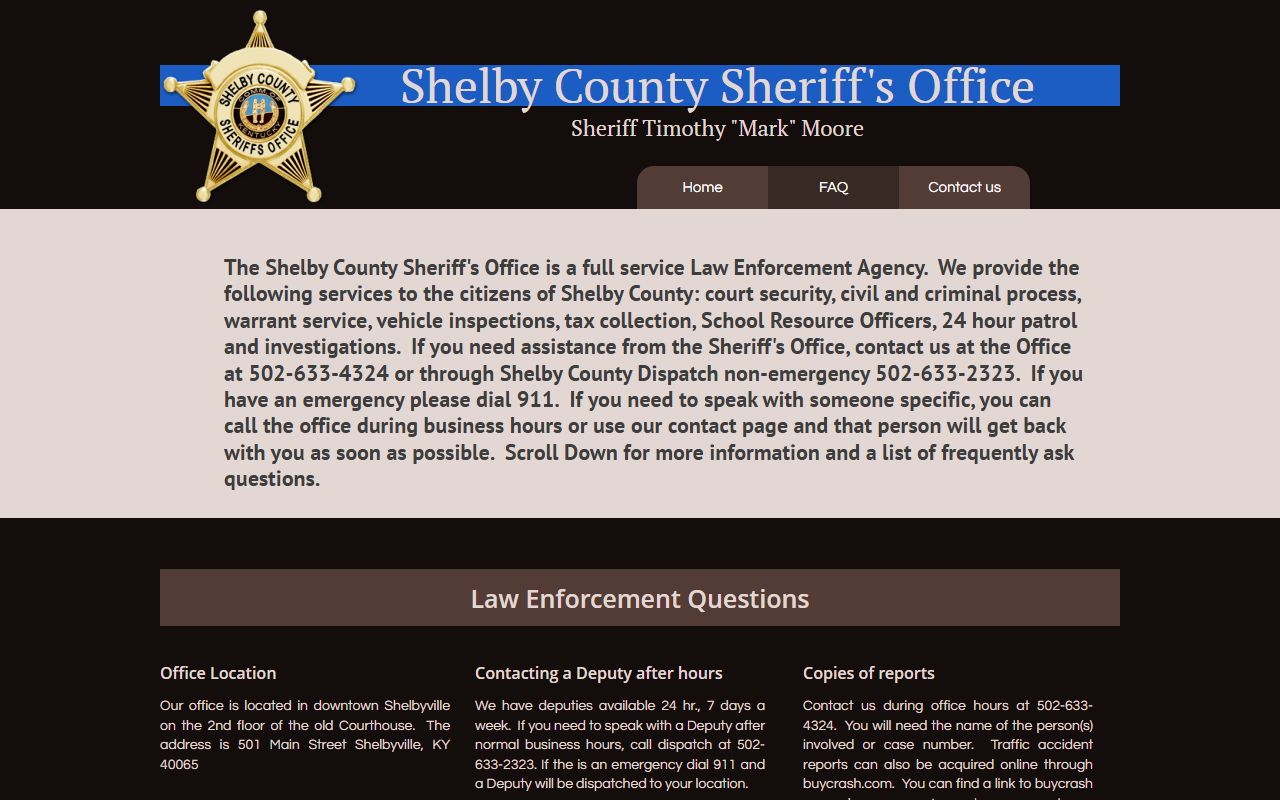
That role helps explain why a law-enforcement contact may be needed for reports while the clerk remains the source for court records.
Charges, Convictions, and Expungement
Being arrested, charged, and convicted are separate steps. A jail arrest means a person was taken into custody. A charge is an accusation filed or tracked in court. A conviction is a final outcome after plea, verdict, or other judgment. Kentucky open-record law may allow access to many nonexempt records, but it also contains exemptions. Sealed or expunged cases require extra caution because old online data may no longer match the current public record.
| Point of Comparison | Charge | Conviction |
|---|---|---|
| Stage | Accusation after arrest or prosecutor filing. | Final court outcome after plea or finding. |
| Proof level | Not proof of guilt. | Entered by the court as an outcome. |
| Where to verify | Docket, charging document, clerk file. | Judgment, sentencing order, clerk file. |
KRS 431.076 provides an expungement pathway for certain acquittals, dismissals, and charges that do not result in indictment or information. Expungement is not the same as an ordinary docket update. If expungement has occurred, public access may change and third-party cached material may be stale.
| Point of Comparison | Sealed | Expunged |
|---|---|---|
| Public visibility | Hidden or limited from public view by rule or order. | Removed or treated under the expungement order. |
| Best proof | Court order or clerk confirmation. | Expungement order and clerk confirmation. |
| Online effect | May not appear in public portals. | May be removed from public agency access when complete. |
Shelby County Court Record Limits
Kentucky's open-record framework is important, but it does not override every court, juvenile, privacy, or investigative limit. KRS 61.878 lists exemptions that may affect personal identifiers, medical information, juvenile records, victim details, informants, active investigative material, and facility-security information. KRS 17.150 is also relevant to criminal-justice records and Chapter 61 remedies.
Requests should be specific. Name the court, case number if known, defendant name, date range, and exact record sought, such as a docket sheet, complaint, bond order, judgment, sentencing order, or disposition. For certified copies, ask the Circuit Court Clerk because court-record copy practices may follow Kentucky Court of Justice fee schedules rather than jail or sheriff records practices. If an agency denies a public-record request, KRS 61.880 requires a legal basis for the denial and provides an Attorney General review route.
Important: Public court or jail information is not a consumer report and should not be used for FCRA-covered screening decisions.